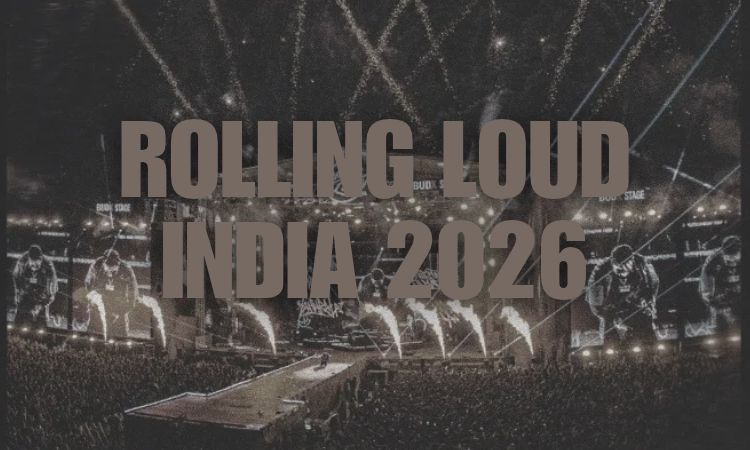
Could Kharghar get loud again? That is the question hanging over the return of Rolling Loud India 2026, after the global hip-hop festival made its Indian debut at Loud Park, Kharghar, drawing more than 65,000 fans and putting the Navi Mumbai node firmly on the map as a destination capable of hosting a festival of international scale.
Rolling Loud is scheduled to return to India on 12 and 13 December 2026. But with the venue and line-up yet to be publicly announced, there is already room for speculation about whether the festival could return to the same ground that hosted its first Indian edition.
And Kharghar has a case to make.
Kharghar has already passed the first test
The first Rolling Loud India was not simply another music event staged somewhere in the Mumbai Metropolitan Region. For two days, Kharghar became a meeting point for thousands of music fans travelling from different parts of the country.
The scale of the event presented the usual challenges associated with a large festival — crowd movement, traffic, security, transport, parking, entry and exit management, and the movement of large numbers of people through an area that otherwise has a very different rhythm.
Yet the festival went ahead at Loud Park, establishing that Kharghar could accommodate an event of Rolling Loud’s scale.
That experience matters if organisers are considering locations for 2026.
The location has practical advantages — and challenges
Kharghar’s location within Navi Mumbai gives it access to the wider Mumbai Metropolitan Region, while its road and rail connections make it accessible to audiences travelling from different parts of the region.
The challenge, however, is not simply getting people to the venue. A festival attracting tens of thousands of people requires careful planning around traffic diversions, parking, public transport, security, emergency access and the movement of crowds before and after performances.
For an event such as Rolling Loud, which brings together international and Indian performers and a predominantly young audience, the venue has to work not only as a concert ground but as a large-scale temporary event ecosystem.
The first edition gave organisers a real-world understanding of what Kharghar could handle — and where improvements might be necessary if the festival were to return.
Rolling Loud is more than a concert for Kharghar
The significance of Rolling Loud’s first edition went beyond the music itself. Kharghar was suddenly being discussed in connection with one of the world’s major hip-hop festival brands. Hotels, restaurants, transport operators and local businesses were exposed to an influx of visitors, while residents experienced the very different atmosphere that accompanies a large international festival, although a large number was disapinted for not haivng any knowledge about what the event was all about, thanks to an isolated event promotion by the organisers.
For a city node that is often described simply as part of the Mumbai region, the event also highlighted Kharghar’s identity as a part of Navi Mumbai.
That distinction became a talking point after the festival, with residents objecting to coverage and promotional material that repeatedly referred to the event as being in Mumbai while the actual venue was in Kharghar, Navi Mumbai (a topic for another time!)
Perhaps Rolling Loud India should move on to another venue in 2026
For all the obvious reasons to want Rolling Loud India back in Kharghar, but, there is another way of looking at it. If the festival is genuinely growing its presence in India, perhaps it should not remain tied to one location.
There is something inherently expansive about a festival such as Rolling Loud. It is a travelling cultural phenomenon, bringing music, artists, audiences and the energy surrounding them into different places. If the Indian edition is to develop its own identity, taking it to another venue — potentially elsewhere in Mumbai (actual Mumbai, this time aaround, and not dubbing and snatching away the identity of Navi Mumbai) — could be a natural next step.
Good things tend to spread. So do people, ideas and culture.
The first edition gave Kharghar its moment (at least musically, if not identity-wise). It brought tens of thousands of music fans into Navi Mumbai and demonstrated that the node could accommodate an event of considerable scale. But that does not necessarily mean the same venue has to host every subsequent edition.
A different venue could allow Rolling Loud to reach a different audience, create new partnerships with local businesses and event infrastructure, and distribute the economic and cultural impact of the festival more widely across the region.
For Kharghar, there is perhaps an even more interesting way to view that possibility. Having hosted the inaugural Indian edition of Rolling Loud, it has already become part of Rolling Loud’s Indian story for ever. A second edition elsewhere would not erase that for aat lest those who knew and acknowledged that it was in Kharghar, Navi Mumbai, and not Mumbai!!!.
In fact, it could strengthen the case for seeing the festival as something bigger than a single venue.
Kharghar had its first chapter. Perhaps 2026 should open another one somewhere else.
Could NMIA play a role in choosing the venue for Rolling Loud India’s second edition?
There is one question that may be worth asking before the 2026 venue is revealed: could NMIA play a role in where Rolling Loud India holds its second edition?
The airport was not operational when Rolling Loud made its Indian debut at Kharghar. It is now.
That alone does not mean anything for the festival’s venue decision. But with Navi Mumbai changing rapidly, and with District once again handling production and exclusive ticketing for the 2026 edition, the circumstances surrounding the next festival are rather different.
Could that make Kharghar — or Navi Mumbai more broadly — a different proposition this time?
The Rolling Loud India 2026 ticket rush may reveal more than the organisers have
There is also an intriguing detail in the build-up to the 2026 edition.
An exclusive 48-hour pre-sale for HSBC cardholders is scheduled to begin at 12 noon IST on 29 September and run until 12 noon on 1 October, followed by general bookings from 1 pm on 1 October. Some fans may also have, though not sure, gained access to tickets through earlier exclusive channels.
That means there may already be people who know considerably more about the event — including its venue — than those waiting for the general announcement.
For everyone else, the ticket sale may be the next point at which the mystery surrounding the 2026 edition begins to clear.
So, could Rolling Loud India return to Kharghar?
There is no official confirmation in the information available here that Kharghar will host the 2026 edition. It is only the whim of a select few who would like it to Kharghar!
But what is known for sure, is that Rolling Loud India 2026, is scheduled for 12 and 13 December 2026, while the venue and artist line-up are yet to be publicly confirmed.
If organisers are looking for a venue with a proven Rolling Loud track record, Kharghar does not have to introduce itself. It has already hosted the festival once. But perhaps that is precisely why moving on could make sense.
A festival that wants to build a lasting presence in India may eventually need to do what successful cultural movements have always done: move, spread and find new audiences.
For now, Kharghar can wait. It has already shown that it can get loud!
Our wish? Let Mumbai get loud for real, this time around!!!