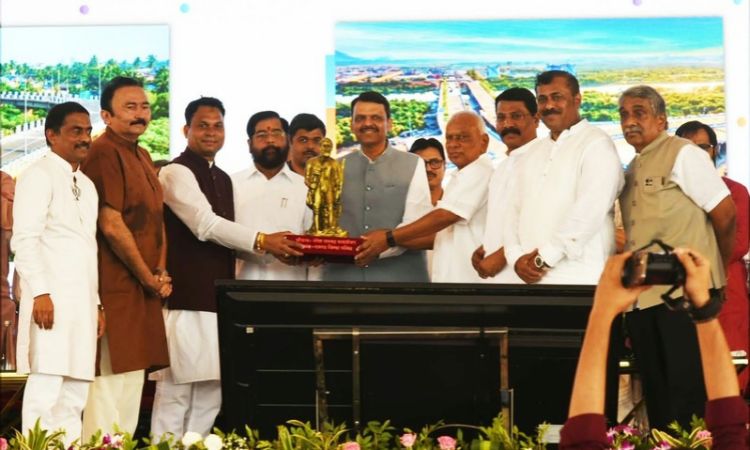
Maharashtra Chief Minister Devendra Fadnavis has set a target of generating 15 lakh jobs through the planned development of the Navi Mumbai Airport Influence Notified Area (NAINA), including five lakh high-paying jobs, and said local landowners and project-affected people would be given priority in the opportunities created by the emerging urban region.
Speaking at Shirdhon in Panvel taluka, where infrastructure works in the NAINA region were launched and key road connectivity projects serving Navi Mumbai International Airport (NMIA) were inaugurated, Fadnavis said the planned development of the region would make ‘Third Mumbai’ a new growth engine for Maharashtra.
He stressed that development must extend beyond roads, buildings and new urban settlements to include employment, water supply and other essential facilities. The government, he said, would work to build the confidence of farmers, involve them as partners in development and address their grievances.
The programme included the inauguration of the SBR-9, BR-4 and BR-5 connectivity projects and the Uran Bypass, which are intended to strengthen access to NMIA from its eastern side. Property cards were also distributed to local landowners.
Deputy Chief Ministers Eknath Shinde and Sunetra Ajit Pawar attended the programme, along with elected representatives, senior officials and local leaders.
Fadnavis promises support until landowners’ grievances are resolved
Fadnavis said the Navi Mumbai International Airport should not be viewed merely as an aviation facility but as a major catalyst for economic development across the surrounding region.
An integrated development plan and town planning schemes are being used to guide the development of the airport’s influence area, he said, adding that the process was intended to create employment opportunities through planned urban growth.
The Chief Minister said the government had decided that development works should be launched after landowners received the relevant documents concerning their land. Village-level surveys, identification of plots, verification of ownership records and the preparation of necessary documentation were being undertaken as part of the process.
He assured landowners that the state government would stand by them until their grievances were resolved.
Fadnavis also acknowledged the sustained efforts of Panvel MLA Prashant Thakur and Uran MLA Mahesh Baldi to ensure that farmers and project-affected families were consulted and their concerns addressed.
He referred to the legacy of the late D. B. Patil, who led the struggle for the rights of project-affected people, and said former MP Ramsheth Thakur had continued to raise the concerns of local landowners with the government.
The Chief Minister said the government was working towards resolving outstanding issues and would remain committed to the interests of farmers and local residents. He added that building trust among landowners, the City and Industrial Development Corporation of Maharashtra Limited (CIDCO) and the state government was essential to ensuring that development proceeded while safeguarding local interests.
Third Mumbai planned around multiple economic centres
Fadnavis said the NAINA region would be developed through a range of concepts, including an EduCity, MediCity, Sports City, AeroCity and Knowledge City, creating opportunities across different economic and social sectors.
He said the development of Thane, Navi Mumbai, Raigad and Palghar would be increasingly important to Maharashtra’s economic growth, alongside established and emerging centres such as Mumbai, Pune, Chhatrapati Sambhajinagar and Nagpur.
The broader objective, he said, was to develop the region in a planned manner while protecting the interests of the people whose land had contributed to its expansion.
Shinde says development charges waived, freehold process nearing completion
Deputy Chief Minister Eknath Shinde described the programme as an important step towards accelerating development in the NAINA region and addressing issues that had remained unresolved for years.
He said NMIA and the Atal Setu had opened new development opportunities for Panvel, Uran, Navi Mumbai and Raigad. The newly inaugurated connectivity projects would improve access to the airport and strengthen links with the Mumbai–Pune Highway and other national highways.
Shinde said decisions had been taken to reduce development charges and betterment charges to zero in response to landowners’ concerns. The process relating to freehold rights was also in its final stages, he said.
The distribution of property cards would help formalise ownership records for the relevant plots, he added.
Emphasising the need to recognise the contribution of people who had given up land for development, Shinde said local farmers and landowners must receive a fair share of the benefits generated by the projects.
He said the government was planning the NAINA region with the needs of the next 25 to 50 years in mind and was working to improve road and metro connectivity among Mumbai, Navi Mumbai and the proposed Third Mumbai.
The government’s approach, he said, was based on ‘Trust, Transparency and Transformation’, with a commitment to justice for landowners, local employment and better infrastructure.
Sunetra Pawar highlights benefits of airport connectivity projects
Deputy Chief Minister Sunetra Ajit Pawar said planned development in the NAINA region, supported by improved connectivity to NMIA, would create new employment opportunities for local residents.
She said the SBR-9, BR-4 and BR-5 connectivity projects, involving an expenditure of approximately ₹953 crore, would make journeys to the airport faster and smoother for travellers from Pune, Panvel, Thane and Kalyan.
The Uran Bypass, costing approximately ₹50 crore, was expected to ease traffic congestion in Uran and improve travel for local residents, fishermen and farmers, she said.
She also referred to the Ulwe Coastal Road, Atal Setu and other connectivity links, saying their integration with the airport and NAINA’s planned development could stimulate industry, trade, services and tourism.
Such development, she said, could create employment opportunities for local youth, ease the pressure on Mumbai and strengthen Navi Mumbai and Raigad as economic centres.
Prashant Thakur raises farmers’ rights, water shortages and housing regularisation
BJP Maharashtra secretary and Panvel MLA Prashant Thakur said the success of NAINA should be measured not merely by roads, buildings or investment figures, but by the improvements it brings to the lives of the farmers whose land has enabled the development.
He urged the government and CIDCO to involve farmers in the process, resolve their grievances and ensure that they receive the benefits to which they are entitled.
Recalling the history of development in Panvel and Uran, Thakur referred to the establishment of Navi Mumbai, the Jawaharlal Nehru Port and the development of NMIA. He said the region’s transformation had been shaped not only by infrastructure projects but also by the struggles of local landowners.
He recalled how the late D. B. Patil led the movement for the rights of project-affected people when land acquisition for Navi Mumbai began in the 1970s. That struggle helped establish the principle of providing project-affected farmers with developed plots under the 12.5 per cent scheme, he said. A 22.5 per cent developed-plot arrangement was subsequently adopted in connection with the airport project.
Thakur said the underlying principle should remain that those whose land is acquired must become respected partners in development rather than remain project-affected people without clarity about their future.
He noted that NAINA was announced in 2013 and that town planning schemes had since raised concerns among farmers about the location of their final plots, the 40 per cent developed-plot share and the treatment of existing village settlements and houses.
While acknowledging that discussions with the government had helped address some concerns, he said CIDCO must continue to build confidence among landowners and resolve outstanding issues at every stage.
Water supply remains a concern
Thakur said the expansion of infrastructure in Panvel and Uran must be accompanied by attention to residents’ basic needs, particularly drinking water.
He pointed out that Navi Mumbai receives water from the Morbe Dam in Raigad district, while several villages in the surrounding region continue to face shortages.
Citing figures of 280 litres per person per day for Navi Mumbai and less than 120 litres per person per day in the local areas he was discussing, Thakur called for a fairer distribution of water resources.
He urged the Chief Minister and Deputy Chief Ministers to convene a meeting involving the relevant authorities and local bodies to improve coordination and address the shortage.
Seeks implementation of housing regularisation decision
Thakur also raised the issue of houses built to meet residents’ needs, saying that a decision concerning their regularisation had been taken in September 2024 but was not being implemented effectively.
He said residents faced difficulties when repairing or rebuilding ageing houses, with some receiving notices from CIDCO after starting construction work. He also expressed concern about action being threatened against houses built by farmers on their own land in the NAINA region.
He called for the decision to be implemented on the ground so that residents could obtain relief, and urged officials to consider local circumstances rather than focus solely on enforcement.
Thakur said he would continue to engage with CIDCO and seek government intervention wherever necessary to resolve the concerns of farmers and residents.
He said the NAINA project should become an instrument of prosperity for people in Panvel, Uran and the wider Raigad district, rather than simply another urban development scheme.
Mahesh Baldi seeks clarity on land rights and rehabilitation
Uran MLA Mahesh Baldi said local farmers, project-affected families and tribal communities must receive priority as the NAINA project advances.
He said the region covered approximately 225 square kilometres and that the project had moved from a period of uncertainty towards greater optimism over the preceding five years and five months. Discussions involving the Chief Minister, Eknath Shinde and other leaders had helped address some of the questions troubling farmers, he said.
However, Baldi stressed that important issues remained unresolved, including where landowners would receive their final developed plots, what they would gain from the 40 per cent share remaining after 60 per cent of the land was allocated to CIDCO, and how the project would develop in practice.
He said opposition among farmers was not opposition to development itself but arose from concerns about administrative shortcomings and uncertainty over their rights.
Referring to the wider history of land acquisition in the region, Baldi said some project-affected families had waited for decades for their entitled plots. Even where plots had been allotted, the absence of roads, electricity and other basic amenities had created further difficulties.
He called for CIDCO officials to be held accountable, administrative procedures to be improved and outstanding issues to be resolved within defined timelines.
Calls for suitable rehabilitation of tribal communities
Baldi also raised concerns about the rehabilitation of the Katkari tribal community. He questioned whether relocating members of the community to multi-storey buildings would adequately address their needs, given their traditional livelihoods and social and cultural practices.
He called for a separate and appropriate rehabilitation plan that takes account of the community’s social, economic and cultural circumstances.
He also urged the authorities to resolve pending issues affecting five villages in the NAINA region, saying that delays in decision-making were holding back development and causing difficulties for residents.
Raises further road connectivity demands
Baldi called for the Uran Bypass project to be expedited. He said the first phase had begun but that the second phase would require land acquisition and additional funding, estimated at approximately ₹15–17 crore.
He also proposed an alternative road connecting the area near the ONGC project in Uran with Karanja fishing harbour. The Public Works Department had prepared an estimate of approximately ₹65 crore for the road, he said, suggesting that its inclusion in the relevant Mumbai Metropolitan Region Development Authority (MMRDA) development plan could help advance the project.
Baldi further urged the authorities to provide clear information to farmers and project-affected people about the implications of other proposed development projects in the region, including those involving MMRDA. He said residents needed clarity about the future of their land and how they would participate in the benefits of development.
The concerns over farmers’ land rights, water supply, housing regularisation and rehabilitation are examined in greater detail in our report on the issues facing communities affected by NAINA’s development.
CIDCO outlines its responsibility for 94 villages
In his introductory remarks, CIDCO Vice-Chairman and Managing Director Ashwin Mudgal said NMIA was giving a new direction to development in Navi Mumbai, Panvel, Uran and the surrounding region.
CIDCO, as the special planning authority, was responsible for the planned development of 94 villages spread across approximately 225 square kilometres, he said.
The objective was to integrate airport development, transport infrastructure, urban planning and future economic opportunities to create a modern, well-connected and sustainable urban centre.
Property cards distributed to local landowners
During the programme, Chief Minister Devendra Fadnavis distributed property cards to ten local landowners:
- Rajaram Valku Patil
- Ramchandra Shankar Bhoir
- Namdev Maruti Bhoir
- Devendra Janardan Bhagat
- Dhanaji Shankar Kutle
- Jagdish Waghmare
- Ganesh Gaykar
- Waman Ganpat Waghmare
- Nilesh Dashrath Waghmare
- Vinod Waghmare
The distribution formed part of the process of documenting land ownership in the region.
Elected representatives and officials attend
Those present on the dais included Deputy Chief Ministers Eknath Shinde and Sunetra Ajit Pawar; Raigad Guardian Minister Bharat Gogawale; former MP and local leader Ramsheth Thakur; Raigad Zilla Parishad president Mangesh Wakadikar; MPs Shrirang Barne and Sunil Tatkare; MLAs Prashant Thakur, Mahesh Baldi, Niranjan Davkhare, Aniket Tatkare, Dnyaneshwar Mhatre, Vikrant Patil, Ravindra Patil and Mahendra Dalvi; Atul Patil, son of the late D. B. Patil; former municipal president J. M. Mhatre; Panvel Mayor Nitin Patil; Raigad Collector Kishan Jawale; Zilla Parishad Chief Executive Officer Neha Bhosale; BJP North Raigad president Avinash Koli; CIDCO Vice-Chairman and Managing Director Ashwin Mudgal; CIDCO joint managing directors Shantanu Goyal, Raja Dayanidhi and Ganesh Deshmukh; and Chief Administrative Officer Suresh Mengde, among other officials and dignitaries.
The programme highlighted the government’s development ambitions for the NAINA region, alongside continuing demands from local representatives for landowners’ rights, rehabilitation, reliable basic services and a greater share for local communities in the benefits of growth.