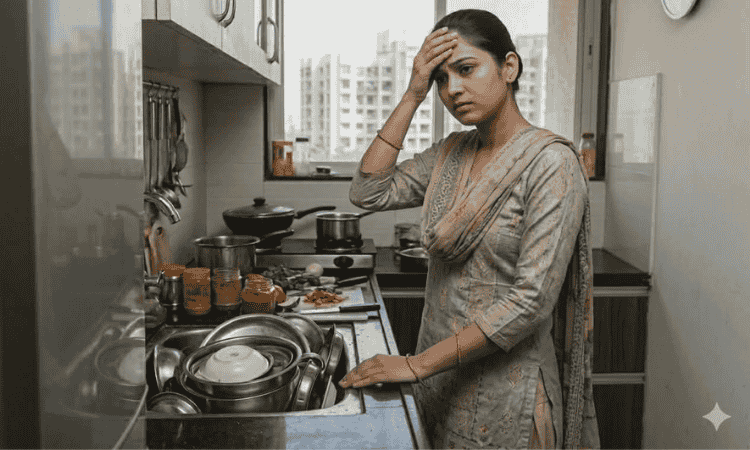
Across several housing societies in Kharghar, daily routines have been quietly upended over the past few days, as a large number of domestic workers, maids to be precise, have returned to their native places in West Bengal to participate in the ongoing election process scheduled between April 23 and April 29.
What initially appeared to be a routine wave of leave requests has revealed a striking pattern — many households across sectors such as 30, 34, 35, 36 and 37 rely heavily on domestic workers from West Bengal. Their simultaneous absence has left residents scrambling to manage household chores, with many rediscovering long-forgotten responsibilities.
Morning schedules have shifted, kitchen duties reassigned, and in some homes, reluctantly embraced. For a locality accustomed to a certain rhythm, the disruption has been both immediate and telling.
The Verma family in sector 35, shared, “We kind of depend on our maid for everything, as we have tight daily routines, both spouses being bread winners. However, our maid is off to her native place in West Bengal for the ongoing elections. Ideally it should have been 3-4 days but she has taken a long leave. So, for now, we are in a fix, and pretty much struggling to cook food early in the mornings, washing dishes and all other things. I have applied for a leave myself to be able to handle household work as i have school -going children.”
A dependence brought into focus
The episode has, perhaps inadvertently, highlighted the extent to which a significant number of households in Kharghar depend on domestic workers from a specific region. While migrant labour has long supported urban living, moments like these bring that reliance into sharper focus.
“It is the same scenario in other households in our society, as well as in sector 34, 35, 36 etc. where several of our friends reside. Their maids, also hailing from West Bengal, are gone for the elctions,” the Vermas added.
Shift in workforce dynamics
The situation also points to a noticeable shift in the domestic workforce over the years. Traditionally, a large section of domestic work in the region was carried out by local Maharashtrian women. However, residents now observe that workers from West Bengal have steadily increased in number, with many households across Kharghar employing them for domestic help.
Many of these workers initially entered the sector at comparatively lower wage levels, making their services more accessible to a wider range of households. Over time, as their numbers and demand have grown, there has been a gradual shift in this dynamic. Residents note that monthly wages for domestic help have been steadily rising, reflecting both increased demand and changing expectations around work and availability.
This change appears to be driven by a mix of factors, including availability, mobility and willingness to take up such work on a full-time or flexible basis. As a result, in several pockets of Kharghar, migrant workers now form a significant part of the domestic workforce, particularly in the household segment.
The Patels residing in setor 35 D, shared, “The maids from Westy Bengal are easy to find, very flexible, hard-working and most importantly, cheaper than locals. Only recently here has been soe hike in the monthly charges, but overall, it is an affordable bargain. It is not the same with local maids as they are pretty expensive and inflexible in comparison.”
Some other businesses and services too feel the pinch
The same pattern extends beyond domestic work. In several parts of Kharghar, migrant workers from West Bengal are also engaged in occupations such as construction, carpentry, tailoring, as well as running small businesses including vegetable and coconut water vending. Their temporary absence during the election period has been noticeable across these sectors too, subtly affecting everyday services and reinforcing the extent to which the local economy relies on this workforce.
A temporary disruption, a lasting reminder
For now, the disruption is expected to be temporary, with workers likely to return once the election process concludes.
But for many households, this brief pause has offered an unfiltered glimpse into the workforce that quietly sustains urban living — and how quickly its absence can be felt.