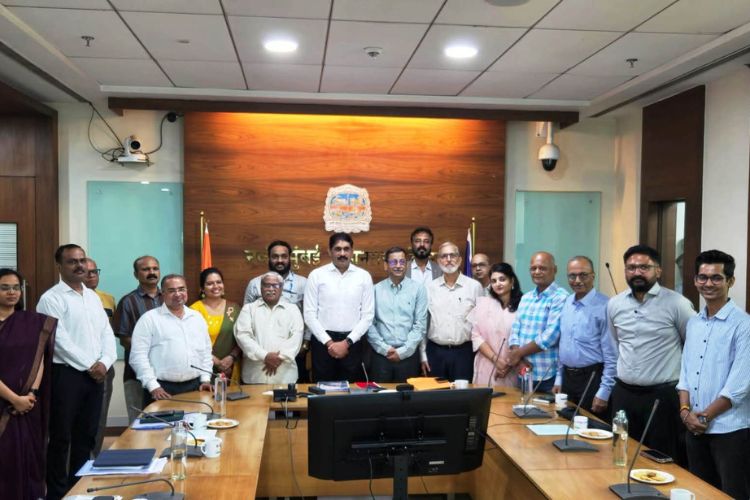
Navi Mumbai is steadily positioning itself towards becoming a future-focused “Recycle Hub”, with the Navi Mumbai Municipal Corporation (NMMC) initiating discussions on innovative recycling models, decentralised waste management systems and sustainable environmental practices in collaboration with environmental organisations, researchers and civic groups.
A special meeting chaired by Municipal Commissioner Dr Kailas Shinde was recently held to deliberate on practical and long-term solutions for urban environmental challenges, particularly the scientific recycling and reuse of Plaster of Paris (POP) idols after immersion during festive seasons.
During the meeting, representatives from the Institute of Chemical Technology (ICT) presented several innovative concepts related to POP recovery and recycling. This included details of an experimental POP recovery project, decentralised waste management models and small-scale waste processing technologies aimed at reducing the burden on conventional waste disposal systems.
ICT representatives also proposed the concept of establishing a dedicated recycling project in Navi Mumbai. Municipal officials stated that the feasibility of such a project would be examined further.
Representatives from idol-makers’ associations reportedly expressed willingness to reuse recycled POP material for the creation of new idols, marking what officials described as a significant step towards circular and sustainable festive waste management.
Nuoterra Foundation also presented an innovative model showcasing how recycled POP material could be repurposed into useful products such as school furniture, including study tables. The organisation further proposed a memorandum of understanding for systematic collection and reuse of immersed POP idols.
Meanwhile, Project Mumbai presented proposals aimed at encouraging greater citizen participation in environmental initiatives through a dedicated “Citizen Volunteering Portal”. The organisation also introduced its “Agni Suraksha Vision”, a concept focused on building citizen-led volunteer participation to strengthen urban safety and emergency awareness across the city.
Discussions were additionally held regarding Navi Mumbai’s potential contribution during Maharashtra Climate Week 2027, particularly in the area of urban biodiversity management.
Municipal Commissioner Dr Kailas Shinde stated that recent tree census findings had identified over 15 lakh trees across more than 225 locations within the municipal limits. He added that the corporation continues focusing on plantation of native tree species to strengthen the city’s environmental value and biodiversity.
The role of “Civic Marshals” in improving local environmental management and behavioural awareness among citizens was also highlighted during the meeting.
Representatives from the Art of Living Foundation, under its “Eco Kranti” initiative, presented biodegradable alternatives to single-use plastic products and discussed increasing their usage across restaurants and hospitals.
Prespl India showcased a unique initiative involving biomass briquettes manufactured from garden and agricultural waste, which could potentially be used during cremation processes as an alternative to conventional firewood, thereby reducing wood consumption.
During the discussion, Commissioner Dr Kailas Shinde also referred to key provisions under the newly implemented Solid Waste Management Rules 2026. He stressed the need for stronger implementation mechanisms, especially concerning institutions, housing societies and establishments generating more than 100 kilograms of waste daily.
The commissioner further highlighted the need for GPS-based idol traceability systems during Ganeshोत्सव and Navratri festivals to ensure proper immersion management and environmentally compliant disposal practices.
Emphasising the need for scientific handling of POP idol waste, Dr Shinde appealed to experienced researchers and environmental experts to take proactive leadership in developing practical solutions in the sector.
The meeting was attended by NMMC officials including Deputy Commissioner Somnath Potre, Deputy Commissioner Smita Kale, Deputy Commissioner Dr Ajay Gadde and environmental officer Rajesh Pawar, along with representatives from ICT Mumbai, Punjab Renewable Energy Systems, Rotary Club, Art of Living, Project Mumbai, idol-makers’ associations, Beach Please India and several other environmental organisations.
Representatives from Rotary Club also appreciated NMMC’s environmental initiatives and expressed willingness to contribute towards tree conservation efforts in the city.
The meeting additionally featured a presentation on the Textile Recovery Facility (TRF) project being implemented for the first time in the country in collaboration with the Ministry of Textiles’ Textile Committee and Navi Mumbai Municipal Corporation.
Concluding the meeting, Commissioner Dr Kailas Shinde urged participating organisations and researchers to work towards converting innovative concepts into practical, scalable projects capable of creating long-term environmental impact for the city.
Officials stated that the meeting marked an important step towards Navi Mumbai’s larger vision of emerging as a structured and sustainable urban recycling hub.