Republic Day in Kharghar was not confined to society courtyards or flag hoisting ceremonies. It unfolded, gently and almost unnoticed, along the node’s everyday streets.
By mid-morning, the signs were everywhere.
Scooters zipped past with small Indian flags mounted proudly at the front. Cars rolled by with tricolours fluttering against the windshield. Some drivers slowed instinctively at crossings, as if the day itself demanded a little more courtesy than usual.
Outside apartment gates, residents stepped out dressed for the occasion. Women in white suits and sarees paired with tricolour chunnis. Men in crisp kurtas with tiny flag brooches or paper flags pinned neatly to their chests. Children, still clutching paper flags from morning ceremonies, hopped alongside their parents, occasionally breaking into fragments of the National Anthem with endearing seriousness.
Shops join the celebration
Local markets, too, carried the mood.
Shopfronts across Kharghar were decorated with paper flags, ribbons and small tricolour cut-outs. Grocery stores, medical shops and bakeries alike made modest but thoughtful efforts to mark the day.
At some counters, shopkeepers greeted customers with a quiet “Happy Republic Day” before returning to their billing machines — patriotism folded seamlessly into routine commerce.
Flags on Wheels, Pride on Display
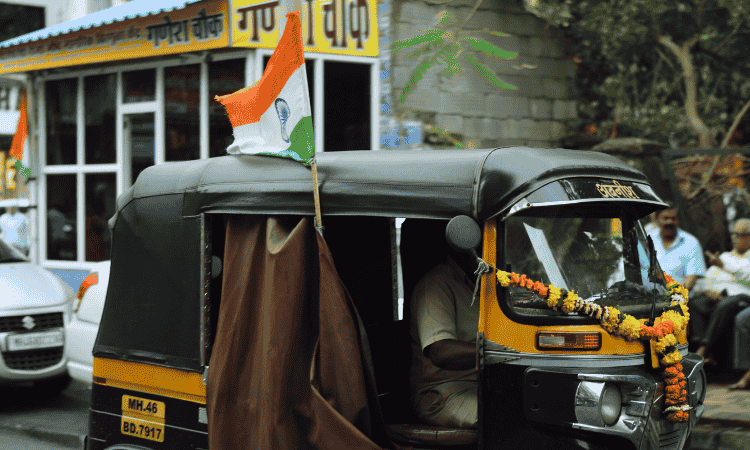
Perhaps the most telling image of the day was the steady flow of traffic carrying tiny flags, and even bigger ones.
There was no procession. No announcement. Just hundreds of private vehicles quietly participating in the same unspoken ritual — especially the autorickshaws, which were a moving display of everyday nationalism that felt more sincere than ceremonial.
For a moment, Kharghar’s busy junctions looked softer. Kinder. Almost festive.
A Day Worn, Not Announced
There were no loudspeakers blaring patriotic songs on the streets. No grand banners strung across roads.
And yet, the Republic was everywhere. In the way strangers nodded to each other at crossings, in the way children refused to let go of their paper flags, in the way shopkeepers had bothered to decorate at all, and in the way people dressed — not extravagantly, but deliberately.
The Republic, Quietly Alive
Republic Day in Kharghar this year was not a spectacle you travelled to watch. It was something you simply walked into.
It lived in the details — on scooter handles, on kurta pockets, in shop windows, in children’s hands sticky with jalebi syrup.
And for a few gentle hours, the node moved not just with traffic, but with a shared, unspoken sense of belonging.