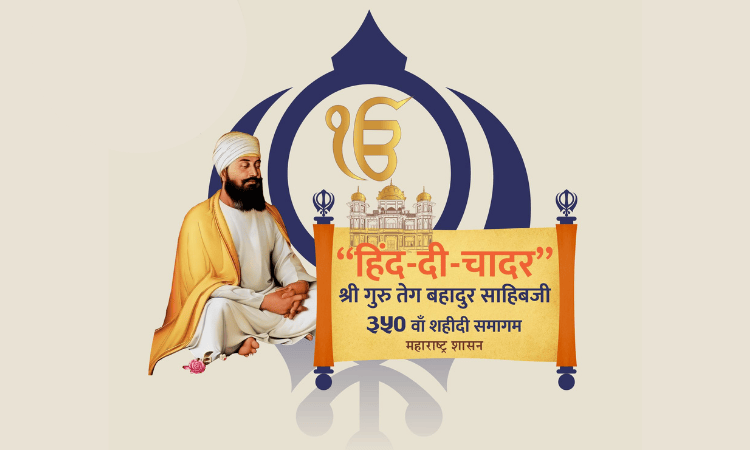
The Kharghar Gurudwara Shri Guru Singh Sabha, and the Sikh community of Kharghar are gearing to host one of the largest religious congregations that the node has ever witnessed.
The 350th Shaheedi Samagam of Guru Tegh Bahadur, revered as ‘Hind-Di-Chadar’ (Shield of India), will be held on February 28 and March 1 at the Owe ground in sector 29 — one of the land parcels officially marked for the proposed International Corporate Park (ICP).
Authorities estimate that between 15 and 20 lakh devotees could attend across two days. Apart from them, around 25,000 Sikh saints and devotees from Punjab will be attending the Hind-Di-Chadar event. Needless to say, for a residential node like Kharghar, this is nothing less than an event of national scale.
State-Level Commemoration of Hind-Di-Chadar event
The Hindi-Di-Chadar event in Kharghar is not a standalone event. Similar commemorations are being organised in Nanded and Nagpur as part of the 350th martyrdom anniversary observances of Guru Tegh Bahadur.
Reports indicate that the Maharashtra state cabinet has allocated approximately ₹95.35 crore for arrangements across all locations.
PM Modi among prime dignitaries for Hind-Di-Chadar event
Being a state-level event, several senior dignitaries are expected to attend or address the gathering virtually. Prime Minister Narendra Modi is reportedly likely to attend and address the grand Hind-Di-Chadar event virtually. Other important dignitaries who would be attending the event in person are Union Home Minister Amit Shah, and CM Devendra Fadnavis, along with other senior state leaders.
A lesson from past events: The 2023 Maharashtra Bhushan Tragedy at the Same Venue
The choice of venue for Hind-Di-Chadar inevitably brings back the events of April 2023.
The Maharashtra Bhushan award ceremony held at this same ground resulted in at least 11 heat-related deaths, with several attendees hospitalised after prolonged exposure to high temperatures, which had touched close to 38°C.
The incident led to widespread criticism of planning under extreme heat conditions and raised serious questions about medical preparedness and crowd management.
For residents of Kharghar, that day was not abstract. Ambulances, traffic gridlock, confusion — all unfolded within their neighbourhood.
As a result, the scale of the current event is being viewed through a sharper lens.
Medical Infrastructure and Heat Preparedness during the Hind-Di-Chadar celebrations
Authorities say that medical preparedness this time is significantly expanded.
Arrangements reportedly include:
- 10 temporary health camps
- An on-site ICU facility
- 20 ambulances, including cardiac units
- Reservation of 350 hospital beds, including ICU beds
- ORS distribution counters
- Over 100 water tankers positioned strategically
Officials have indicated that hydration, early response and medical monitoring are central to the planning framework.
Security Deployment and Surveillance Measures at the Hind-Di-Chadar event
Given the expected footfall and VIP presence, security deployment at the Hind-Di-Chadar event will be extensive.
Plans include:
- Approximately 3,000 police personnel
- More than 2,000 trained volunteers
- Over 300 CCTV cameras across the venue
- A centralised command and monitoring system
A restricted vehicular zone of around 1–2 kilometres around the venue has been created to prevent congestion close to the stage area and ensure controlled movement.
Traffic Diversions, Parking and Movement Strategy for Hind-Di-Chadar event
The Traffic department has taken into consideration the heavy inflow of vehicles expected from Mumbai, Thane and Pune. To manage this following arrangements have been made:
- Diversions will be implemented on the Sion–Panvel Highway for heavy vehicles
- Temporary restrictions are planned near Kalamboli Circle and CBD Belapur junction
- Around 30 designated parking grounds have been identified
- A temporary bridge at Kopra has been constructed to ease movement
- Dedicated pedestrian corridors are being created from bus drop-off points to the main venue
With nearly 25,000 heavy vehicles passing daily through nearby JNPA corridors, inter-agency coordination is critical.
Residents in surrounding sectors are likely to experience slower internal movement during peak hours.
Special Bus Services for Hind-di-Chadar event
In a bid to facilitate smooth movement of traffic special NMMT and MSRTC bus services are being arranged. NMMT has made provisions for free buses for the Hind-Di-Chadar venue in Kharghar, from anywhere between Panvel and Airoli. These buses will run from 7:00 am to 11:00 pm, connecting all major key locations such as Belapur, Vashi, Panvel, and several other nodes of Navi Mumbai to the main event venue in Kharghar. Major pickup points include nodal railway stations and bus depots across the city.
Download Hind-Di-Chadar – NMMT’s Free Bus Services/Bus Stops PDF
App for Digital Navigation for Hind-di-Chadar event
The Panvel Municipal Corporation has developed a dedicated mobile app to guide visitors on:
- Parking zones
- Diversion routes
- Shuttle services
- Venue access points
The integration of digital navigation reflects an attempt at structured crowd dispersal rather than ad-hoc management.
(P.S. – No official information on the app has been published yet)
Mass Langar Arrangements at Hind-di-Chadar event
Arrangements for mass langar, serving approximately 2.5 lakh devotees, are being made, with structured serving zones to prevent overcrowding.
Sanitation measures in place
Top priority has been given to sanitation amd related facilities as follows:
- Deployment of around 500 sanitation workers
- Extensive mobile toilet facilities
- Reinforced drinking water supply networks
- Upgraded lighting and electrical arrangements
Anticipation and Participation of Local Residents — Especially the Sikh Community
For many Sikh families in Kharghar, the 350th Shaheedi Samagam is not merely a large public event being hosted in their neighbourhood — it is a deeply emotional milestone.
Guru Tegh Bahadur’s sacrifice is central to Sikh history, remembered not only as martyrdom but as a defence of religious freedom. To witness the grand 350th commemoration being organised in Kharghar carries a quiet sense of honour for the local Sikh community.
Several families have already stepped forward to participate in seva — volunteering in langar arrangements, helping manage queues, assisting elderly visitors, guiding outstation devotees and contributing in whatever way they can. For many, seva is not an optional act; it is a natural extension of faith.
Younger members of the community are preparing to assist in coordination efforts, while elders speak of the event with reverence and anticipation. Homes are readying to host relatives travelling from Punjab, Delhi and other parts of Maharashtra.
At the same time, there are many Sikh residents who are choosing to attend the event in a quieter, cultural manner — participating in prayers, listening to kirtans and simply being present with a sense of pride and service.
Beyond the Sikh community, other residents of Kharghar are also observing the scale of the preparations with interest. For them, it is a moment when their residential node briefly becomes a national congregation point.
There is pride. There is anticipation. There is participation.