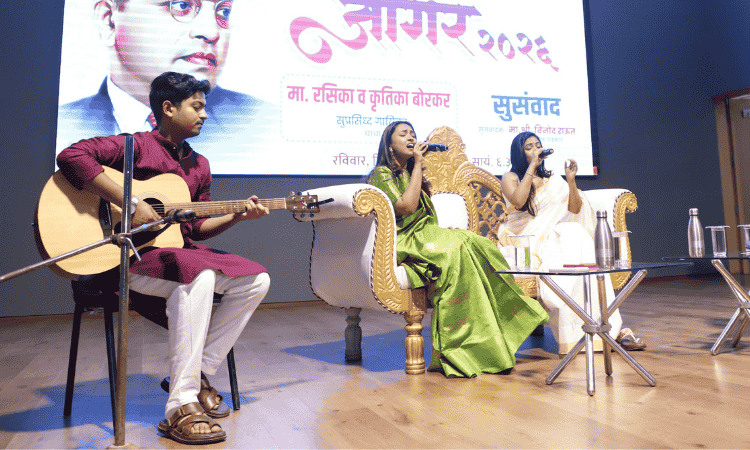
At a time when engaging younger audiences requires a shift in both medium and approach, the Navi Mumbai Municipal Corporation (NMMC) has come up with ‘Jagar 2026’, a unique event in Airoli, using fusion music to carry forward the ideas of Dr Babasaheb Ambedkar.
Organised from April 3 to April 13 at the Bharat Ratna Dr Babasaheb Ambedkar Memorial in Airoli, the ongoing programme brings together lectures, performances and interactive sessions, with multiple events scheduled across its duration.
One of the recent sessions used fusion music as a medium, blending traditional compositions with contemporary arrangements to present Ambedkar’s ideas in a format that remains both rooted and relatable.
Reworking traditional compositions for newer audiences
Rather than simplifying the content, the effort has been to reshape how it is presented.
Traditional songs associated with the thoughts and philosophy of Dr Babasaheb Ambedkar were rendered in contemporary musical styles, allowing younger listeners to engage more naturally while retaining the original meaning and intent.
Session combined performance with dialogue
The session featured vocalists Rasika and Krutika Borkar along with guitarist Nayan Borkar, in an interaction moderated by journalist Vinod Raut.
The format moved between musical presentation and discussion, combining elements of classical, folk and contemporary music. Alongside the performances, the artists spoke about the importance of presenting Ambedkar’s ideas in formats that invite attention and understanding, particularly among younger audiences.
Among those present were Social Welfare Committee Chairperson Ranjana Sonawane, Transport Committee member Yashpal Ovhal, Deputy Commissioner (Education and Ambedkar Memorial) Sanghratna Khillare, Let’s Read Foundation head Praful Wankhede, and a large number of attendees.
Encouraging reading and deeper engagement
During the interaction, emphasis was placed on reading as a starting point to understand Ambedkar’s work.
Participants were encouraged to make use of the library at the memorial and to approach the writings with intent. It was also suggested that readers may begin with the works of Mahatma Phule before moving on to Ambedkar’s writings, given their depth and complexity.
Music as a vehicle for ideas
The discussion also highlighted the role of music in communicating thought.
Folk traditions were noted as historically significant in taking social ideas to wider audiences. It was also mentioned that Dr Babasaheb Ambedkar had an interest in music, including instruments such as the tabla and violin.
References to classical forms such as ‘khayal’, understood as thought, linked music with reflection and introspection.
A message directed at the younger generation
A consistent message throughout the session was directed towards younger audiences.
Participants were encouraged to pursue their interests with commitment, use digital platforms constructively, and engage with Ambedkar’s ideas as relevant guidance rather than distant theory.
Part of an ongoing series
With ‘Jagar 2026’ continuing until April 13, the fusion music session forms part of a wider programme aimed at presenting Dr Babasaheb Ambedkar’s ideas through varied formats.
Upcoming sessions include लोकशाहीर Sambhaji Bhagat speaking on “Dr Babasaheb Ambedkar’s cultural perspective” on April 6, and senior editor Shrikant Bojewar addressing “Dr Babasaheb Ambedkar: Serious and Candid” on April 8.